For a long time, choosing an industrial location in Indonesia meant answering one question: how much land can I get, and how fast? Land size, price per square meter, zoning: that was the whole conversation. But talk to any manufacturer who has actually run a facility for a few years, and you’ll hear a different set of concerns creeping in. Where do my workers live? What happens when the power flickers during a night shift? How do I get finished goods to a port without losing a day in traffic?
Those questions are exactly why the idea of an industrial township has started to replace the old model of buying a plot and hoping the surrounding area keeps up.
The Problem With Land Alone
An industrial park, in its most basic form, is infrastructure and boundary lines: power, water, roads, and a fence. That’s still essential, and it’s still the anchor of any serious investment decision. But a factory doesn’t operate in isolation. It needs a functioning ecosystem around it: reliable logistics, a workforce that can actually get to the gate, housing, schools, and increasingly, digital infrastructure that lets a plant manager monitor operations without physically walking the floor.
This is the gap that industrial townships are built to close. Rather than treating manufacturing, commercial activity, and residential life as three separate problems for three separate developers, a township folds them into one planned environment. West Java’s Rebana Metropolitan corridor is one of the clearest examples of this shift happening in real time, a government-backed development spanning six regencies and one city, explicitly designed to pull investment east of the traditional Jakarta–Bekasi–Karawang industrial belt.
Why Subang, Specifically
Subang sits about 89 kilometers east of Jakarta, and on paper that might not sound like a dramatic move. In practice, the location puts it within reach of infrastructure that took the previous generation of industrial parks decades to accumulate: the Patimban International Seaport (already Indonesia’s second-largest), Kertajati International Airport, the Trans-Java Toll Road, and both conventional freight rail and the Jakarta–Surabaya high-speed rail line once complete.
It’s also close to more than 10,000 existing supply-chain manufacturing companies and a labor pool of over 900,000 people, with competitive wages around USD 207, a meaningful factor for any operations team building a cost model. For a manufacturer trying to reduce logistics lead time or lower total landed cost without relocating out of West Java entirely, that combination of proximity and capacity is hard to ignore.
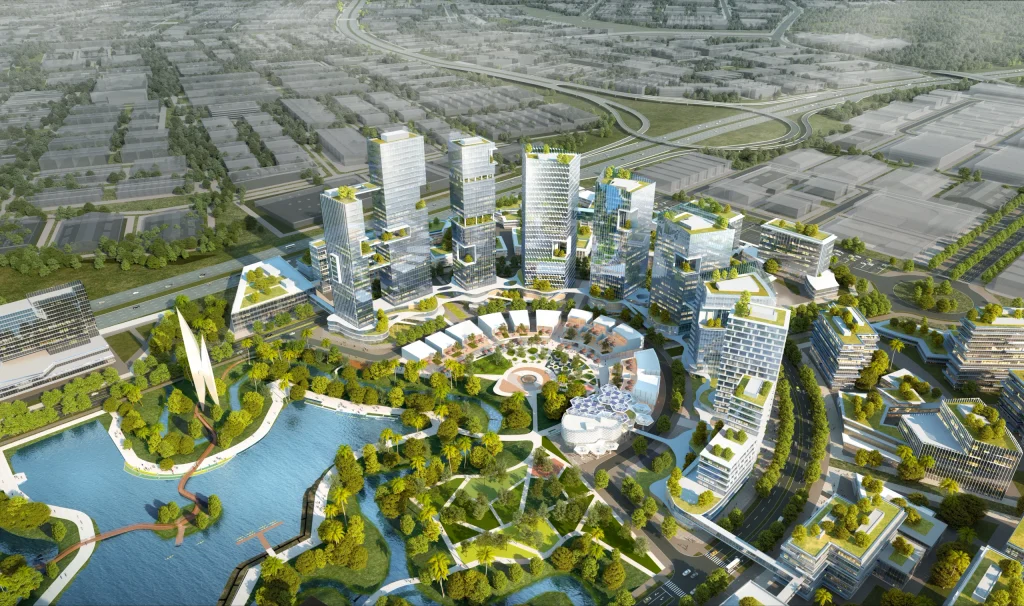
This is the environment Subang Smartpolitan was designed around. Developed by PT Suryacipta Swadaya, the same team behind the long-running 1,400-hectare Suryacipta City of Industry in Karawang, home to over 150 manufacturing tenants, Subang Smartpolitan spans roughly 2,700 hectares and is structured as an integrated township rather than a standalone industrial park: industrial zones sit alongside commercial space, education and innovation facilities, and residential areas, tied together with IoT-based infrastructure for utilities, security, and environmental monitoring.
What “Integrated” Actually Solves
It’s worth being specific about what this integration changes on the ground, because “smart and sustainable” can sound like marketing language until you translate it into operational terms.
Workforce retention. When housing, schools, and daily services exist near the industrial zone instead of an hour away, turnover drops and recruitment gets easier, a real cost saving in a market where skilled labor is competitive.
Utility reliability. Centralized management of electricity, gas, industrial water, and wastewater treatment reduces the kind of unplanned downtime that smaller, standalone parks can struggle to prevent.
Environmental compliance. Built-in air and noise pollution controls matter increasingly to multinational tenants whose head offices track ESG metrics as closely as they track output.
Investor onboarding. Suryacipta has been building out a Smart Core Area with a command center and co-working space specifically aimed at foreign investors going through their first phase of setup in Indonesia: permits, local coordination, the unglamorous logistics of actually opening a plant.
None of this replaces the fundamentals. A company still needs to evaluate land cost, zoning, and utility capacity like it always has. But those fundamentals now sit inside a broader question: will this location still function well in five years, once the surrounding area has to absorb thousands more workers and dozens more tenants? Townships are, in a sense, an attempt to answer that question before it becomes a problem.
A Shift That’s Bigger Than One Project
This isn’t a Subang-only phenomenon. Industry watchers have pointed out that the shift toward integrated industrial townships reflects a broader change in how companies think about long-term site selection, treating an industrial estate less like a warehouse purchase and more like a multi-decade operating environment. Sites designed as complete ecosystems from day one, rather than retrofitted piecemeal as problems appear, are increasingly the ones that win.
For businesses evaluating where to locate or relocate manufacturing capacity, that framing is a useful filter. It’s not just “how much does the land cost,” but “what does this place look like once 900,000 potential workers, hundreds of tenants, and a decade of growth actually show up.” Among the options for best industrial parks in Indonesia, the ones built around that longer horizon are the ones worth a closer look first.
The Bigger Picture
Indonesia’s industrial map is genuinely shifting eastward, and Subang is positioned at the center of that shift, connected to a major seaport, an international airport, national and high-speed rail, and the Trans-Java Toll network, all within a single corridor the West Java government has made a strategic priority. For manufacturers thinking beyond their next lease renewal, that’s the kind of location decision that pays off well past the ribbon-cutting.
About the Author